
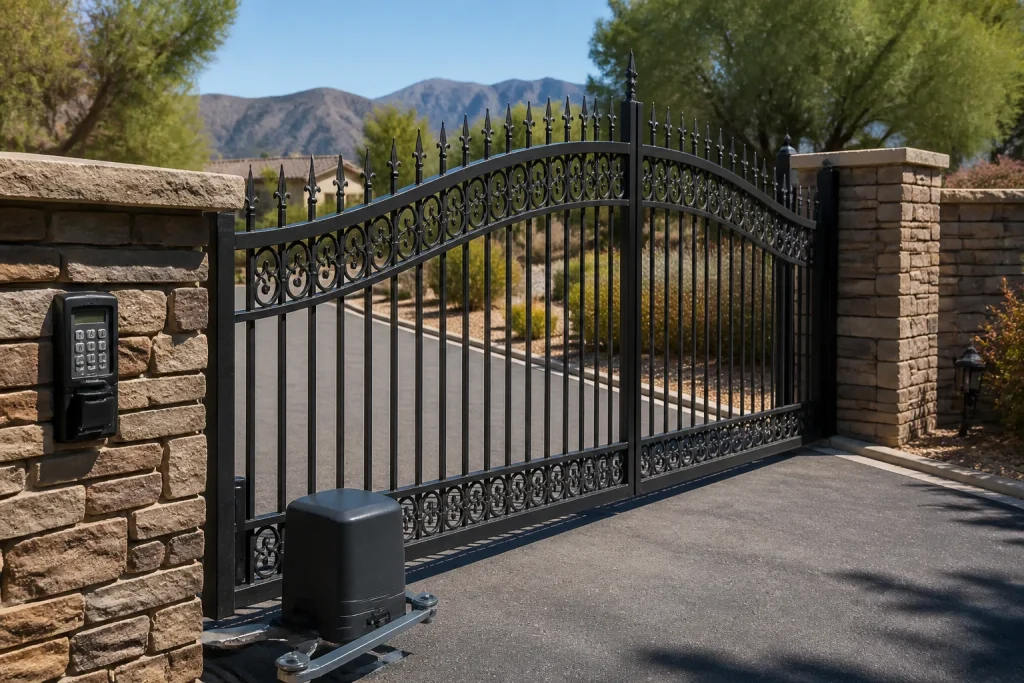
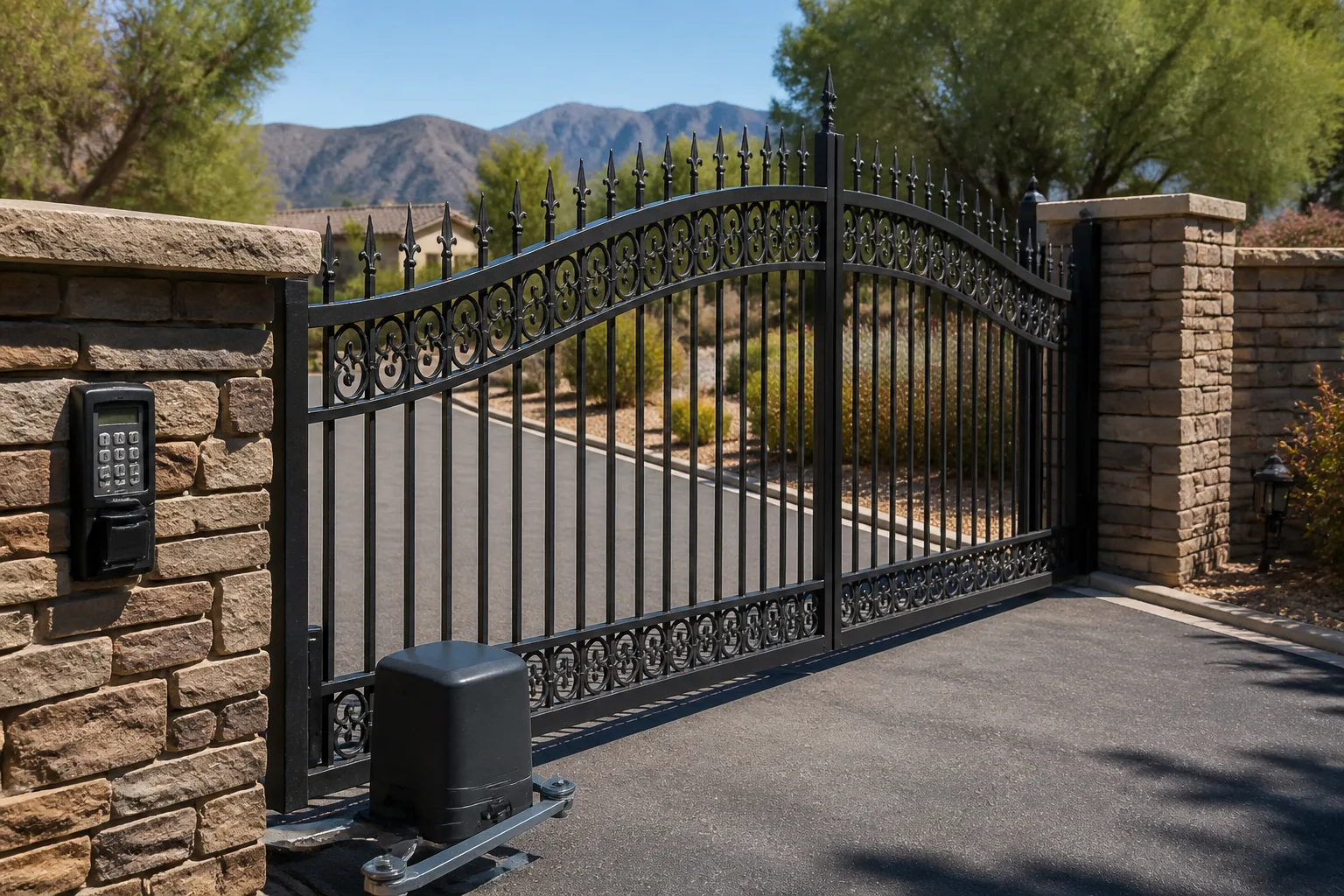
Gate Access Control: Repair or Replace? How Winchester Homeowners Decide
The short answer: on a system under about eight years old, repair almost always wins. On a system past 10 to 12 years, we usually recommend a whole-stack audit first and then a phased replacement, because replacing one part at a time on an aging access control system tends to cost more over three years than a planned swap. If you’d rather not spend your Saturday with a multimeter, call (866) 983-9213 and we’ll tell you honestly which side of that line your gate is on.
Most Winchester homeowners decide this the hard way. Replacing a failed keypad on a 10-year-old system without testing the loop detector, the intercom transformer, and the wiring homerun is like replacing one bald tire on a car with four. You’re statistically scheduling the next service call before you’ve paid for this one. We’ve watched that pattern repeat across dozens of driveway gates in Winchester, and we wrote this piece to help you skip it.
Key takeaways
- Access control components age on different clocks. A keypad, a loop detector, an intercom, and the wiring between them rarely fail in the same year.
- Before any single device gets replaced, the homerun conductors should be tested. Fresh electronics on degraded wire is how the same fault returns in 18-month intervals.
- Loop detectors in Winchester asphalt drift with the seasons, and a “dead” loop is often a sensitivity setting rather than a broken wire.
- A documented package (wiring diagram, model and serial log, loop sensitivity readings, intercom programming export) is what protects you from paying twice for the same diagnosis.
Why does the access control system fail before the gate hardware does?
Because the two are built for different environments. Gate hardware – arms, hinges, rollers, chains – lives in the weather and gets replaced the moment it feels wrong. Access control electronics live in a pedestal, a keypad mounted on a brick pillar, a control box on the column, or inside a sheltered enclosure near the garage. They don’t get slammed, but they do get heat, dust, surface-mount electronics breakdown, and years of small electrical events that never quite kill them.
In Winchester, our summers push pedestal enclosures past 130°F on a sun-facing wall. That heat drives a slow decline in keypad tactile switches and the small electrolytic capacitors that sit on the controller board. The gate will still open. The keypad will still light up. Then, three summers in, one split code and one dead intercom later, the whole stack gets called a “bad system” when really it’s a stack of parts that each ran out at a different time.
Here’s the useful rule: judge the system by its oldest component, not its newest. If the controller board dates to the original install and the keypad was replaced last year, you’re running a 10-year-old brain behind a one-year-old face. The next failure is already in the queue. Before considering gate motor or opener work in Winchester on the same property, it’s worth knowing which clock each part is on.
How do you audit access control component age as a system?
Write down the install date of every device on the property and the model number next to it. This is the single most useful hour a Winchester homeowner can spend on their gate, and almost nobody does it. We’ve pulled more than one install where the keypad had been swapped twice in eight years while the original 2014 controller was quietly the culprit both times.
Walk through these six items and note the age of each:
- Controller board – the brain. Most boards carry a date code or a serial label. Age here matters most.
- Keypad or card reader – the most-serviced part on the property, and the most likely to get blamed for a problem upstream.
- Loop detector or photo-eye safety pair – the sensors that tell the gate whether a car is present or a person is in the path.
- Intercom and its transformer – often the quietest failure in the stack, because a low transformer still lets the intercom ring while the audio goes crackly.
- Low-voltage wiring homerun – the cable from the keypad or pedestal back to the controller. Age is less relevant than condition.
- Power supply and surge protection – if the enclosure has no surge protection and the property has seen a lightning season or two, that power supply is older than its label suggests.
This is the age-mismatch risk in writing: when the youngest part is three or more years ahead of the oldest, replacement of the oldest is usually the better spend. When the parts are within two years of each other, you’re looking at a system that can be repaired year by year with sensible maintenance intervals.
Winchester’s direct-burial wiring degrades on a timeline. Is yours already gone?
This is where most otherwise smart replacements get wasted. Direct-burial low-voltage cable grades and direct-burial landscape-grade cable fail from the outside in. In Winchester, the failure driver isn’t cold. It’s the wet cycle after monsoon rain into sun-baked soil, which softens the jacket and lets soil moisture sit against the copper. The cable doesn’t fail outright. It builds resistance you can’t see.
Test the homerun conductors before a new keypad or intercom goes on the wire. A few minutes with a proper meter tells you whether you’re tuning a new device on a healthy cable or putting lipstick on a corroded one. In practice this looks like:
- Measure resistance end to end on each conductor in the homerun. Compare with the manufacturer’s expected value for that length and gauge. A reading well above spec points to a problem in the soil.
- Check for ground faults in the wet season. A cable that tests clean in July and shows leakage after the first rain is telling you it’s on its last legs.
- Look at the entry point and the splice. Cable usually fails at a splice, a junction box, or where it enters the enclosure – not mid-run.
A Winchester gate repair visit that starts with wiring often ends without a single part being swapped. That’s the best possible outcome for you, even if it isn’t the most profitable one for us.
Why does a loop detector that worked at install now fail every season?
Loop sensitivity drift, and it is quietly the most misunderstood fault we see in Winchester. An inductive loop is a coil of wire buried in the asphalt. When the asphalt expands in summer heat, the coil geometry measurably changes. The detector’s sensitivity setting that was perfect at install is no longer the setting the loop wants. The result: the gate stops sensing a car, or worse, sees a car that isn’t there and leaves the gate cycling.
Two things happen next. Either the homeowner assumes the loop is dead and costs themselves a saw-cut and a new loop, or a technician shows up, replaces a working loop detector board, and the problem returns as soon as the pavement settles. In our experience, a large share of “dead loop” calls in Winchester resolve to a correction of the sensitivity setting, not a replacement.
What a proper diagnosis looks like on a loop detector visit:
- Log the currently set sensitivity, then test at a few steps either side of it.
- Photograph the new position and note it in the job record. Future technicians shouldn’t have to rediscover the right value.
- Test with a real vehicle, not just a hand wave, because a hand doesn’t load the loop the way a car’s mass does.
- Look at pavement condition at the loop cut line. If asphalt has settled around the coil, the geometry is drifting seasonally and you should expect a retune each year.
A loop detector tune-up is a small line item. A loop replacement, complete with saw-cut, new wire, and re-surfacing, is a much bigger one. That gap is why an audit gets done before a quote gets written.
Does replacing one access control part break the rest of the stack?
Sometimes yes, and it’s the failure mode that surprises homeowners most. Controllers from LiftMaster, FAAC, BFT, and the other majors we work on aren’t interchangeable at the protocol level. A new keypad with the latest card-reader format may not speak the same language as a 10-year-old controller. A new intercom may expect a different voltage on the transformer feeding it. Swap one part in isolation and you can end up troubleshooting a compatibility problem you created by trying to fix an unrelated one.
Before any single device gets replaced on a Winchester gate, ask three questions:
- What protocol does the existing controller expect? If the controller is older than the device you’re considering, measure the protocol first.
- What voltage does the new device need? A replacement intercom on an original transformer is a classic mismatch, and it fails intermittently, which makes it the hardest to diagnose.
- What does the wiring in between actually carry? Some older loops, readers, and intercoms use conductors that a modern device expects to be reusable but often aren’t. If the wire is degraded, the new device’s behavior will look random.
The cleanest path on a mixed-age system is to replace either the controller and its accessories together, or to replace matching-vintage parts and leave the rest alone. Anything in between needs a wiring diagram and a documented device log to survive its next service call. That’s the same commercial-grade documentation habit we carried over from access-control work, and it costs nothing extra here.
What belongs in an access control documentation package?
Here’s the difference between paying for a repair and paying twice. A complete access control documentation package, left with the homeowner and filed in the job record, includes:
- Wiring diagram at the controller, showing every conductor, its function, and where it lands. Hand-drawn is fine if it’s accurate and legible.
- Device model and serial log for each access control component on the property, with the install or repair date for each.
- Loop sensitivity readings and the exact setting that was dialed in, plus the date it was set.
- Intercom programming export, or the full program record, so a future technician can reproduce the setup without guessing.
- Photos of what was found, what was adjusted, and any part that was replaced, with the old part number recorded next to the new one.
Under our Haven Standard’s Clause 4, this evidence packet is included on every visit at no additional charge. It’s not a premium tier. It’s the reason the next technician doesn’t charge you to figure out what the last one already knew. We find that Winchester homeowners who have this packet in hand make the repair-versus-replace decision in about five minutes, because the choice is right there in the paperwork.
When to call a pro
Several parts of this work are genuinely safe for a homeowner to check: writing down model and serial numbers, photographing the controller, and observing whether the loop sees a real car. Anything involving opening the controller enclosure, testing live low-voltage conductors, or working under the gate arm is a different story. Low-voltage doesn’t mean harmless – a wrong meter placement on live conductors can destroy a controller board, and a gate arm can move without warning when a controller is powered. If you’re at the point where you’d be opening the control box, that’s the point to call a trained technician.
Related services in Winchester
If your audit points to the operator rather than the access control stack, we cover gate motor and opener repair in Winchester. If your conclusion is that the system has simply run its course, our Winchester gate installation page covers what a planned replacement entails. If you’d like a whole-property picture, start at Vance Gate Repair Winchester home.
The Bottom Line
Repair or replace is the wrong question on its own, because the answer depends on the age spread across your whole access control stack, not on the part that failed last week. Three rules to take with you:
- Test the wiring homerun before trusting a new device on old wire. Resistance and wet-season ground faults are visible now, not later.
- Treat a “dead” loop detector as a sensitivity question before it becomes a pavement question. Winchester asphalt drifts; the setting sometimes needs to follow.
- Match vintage to vintage when replacing. A new part on a much older controller can break compatibility and turn a simple job into a diagnostic puzzle.
Every quote we write is a flat written price, handed over before any tool is opened, and backed by the 365-Day Done Right Promise on the work we complete. If you already have a written estimate from another company and want a second opinion on it, we’ll review the paperwork at no cost – no pressure, no obligation. If you’re in Winchester and want to talk through your gate, Vance Gate Repair Winchester offers free estimates. Call (866) 983-9213.
Frequently Asked Questions
Most access control repairs in Winchester land between $150 and $350, depending on whether a single device is involved or a wiring or compatibility problem is being diagnosed. Loop detector sensitivity tuning usually runs $95 to $175, and keypad replacement runs $185 to $360 for the part and installation. Every price is quoted in writing before work starts, so the number on the invoice matches the number you agreed to. Call (866) 983-9213 for an exact figure.
On standard repairs, yes – we run same-day appointments for access control problems in Winchester, and a live person answers the phone at any hour. What we won’t do is promise same-day service on a planned replacement. A full access control swap needs measuring, ordering, and scheduling. Call (866) 983-9213 and we’ll tell you honestly which timeline applies to your gate.
A full replacement includes the controller, keypad or reader, intercom, loop detector or photo-eye pair, power supply with surge protection, and the wiring homerun if the old cable tests out of spec. It also includes the documentation package: wiring diagram, device log, loop sensitivity readings, intercom programming export, and photos at handoff. We schedule it after a free measurement visit and hand you a written price before anything is ordered. Call (866) 983-9213 to book the measurement.
Yes – the low-voltage power run to the pedestal and the safety photo-eye pair are part of every access control job we take on. The photo-eye pair is the infrared beam that stops the gate if something crosses the path, and it must be tested and aligned on any replacement. Call (866) 983-9213 for a free estimate on the full scope.
Written by the team at Vance Gate Repair Winchester.
Need Gate Repair Help?
Call Vance Gate Repair Winchester - licensed & insured, here with fast after-hours help in Winchester.
(866) 983-9213