
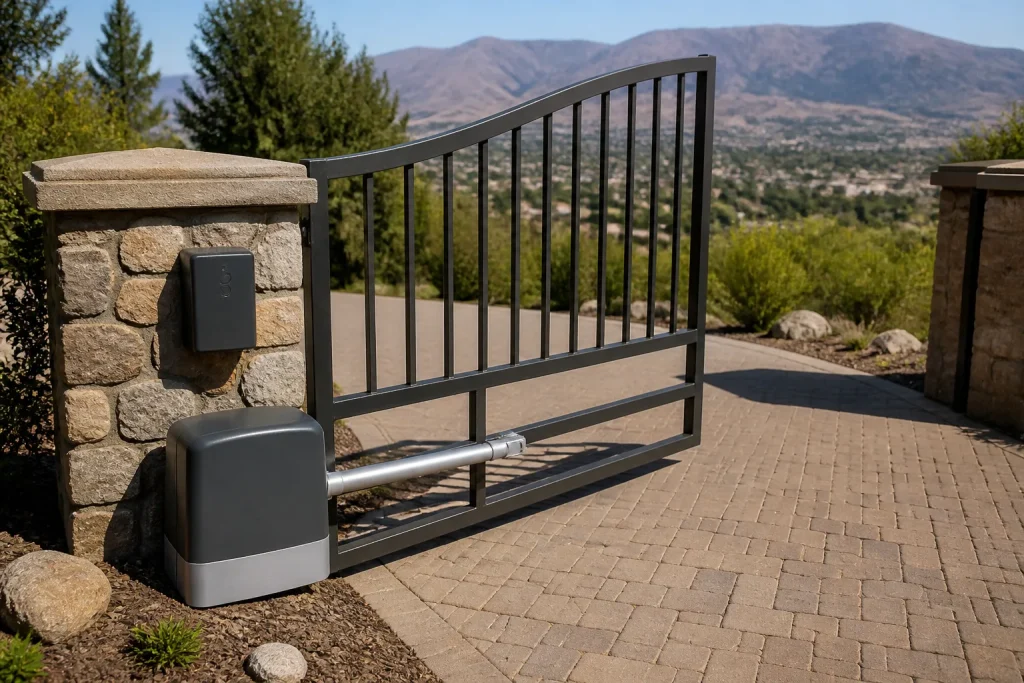
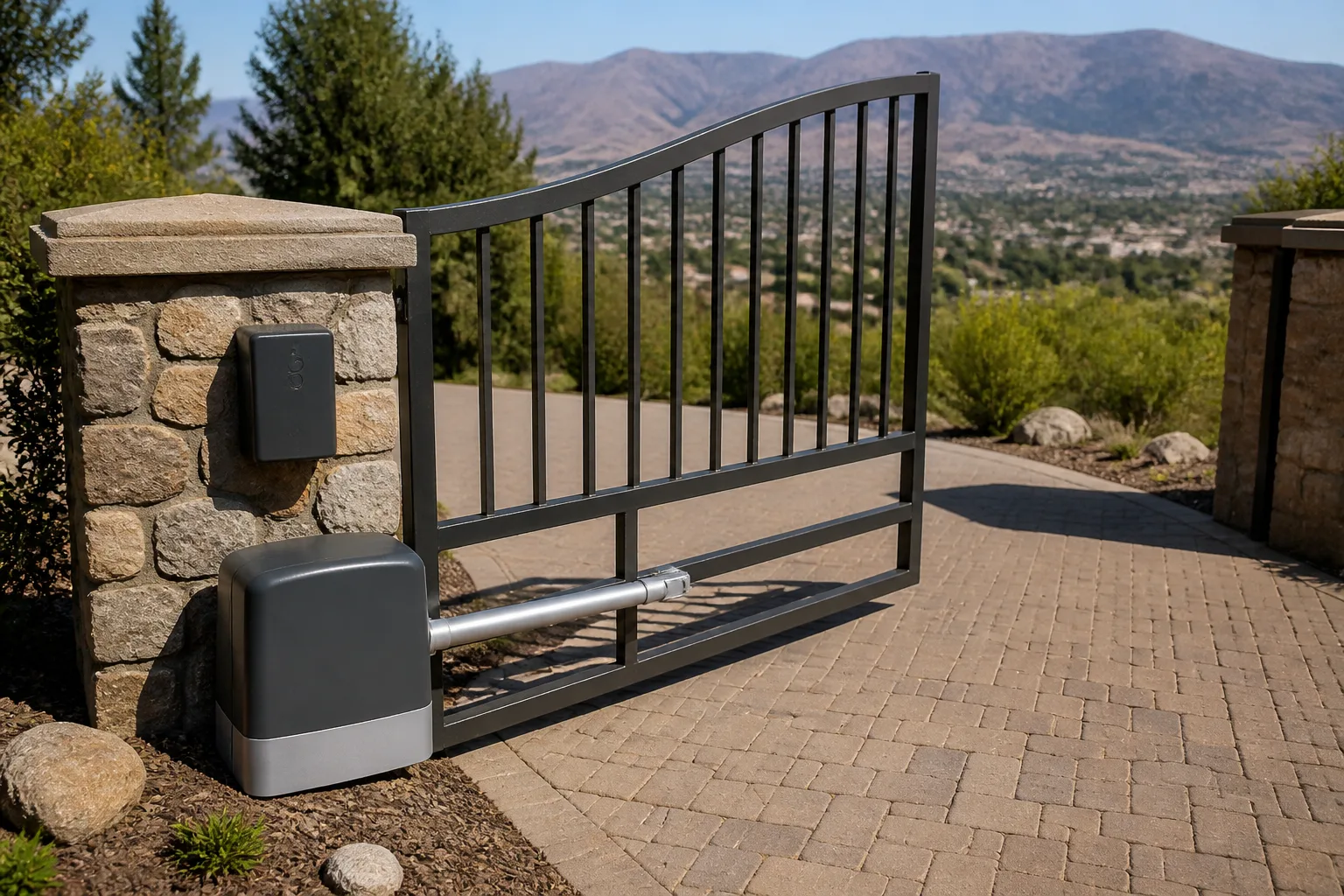
FAAC Gate Repair in Winchester: A Homeowner’s Guide
Most FAAC operators that “just stopped working” still have a perfectly good motor inside. The fault almost always sits upstream, in a starting capacitor or a logic board, and confusing those two is the most expensive mistake we see homeowners make with this brand. A $40 capacitor can get swapped for a $600 board when nobody reads the fault codes first. This guide walks through how a FAAC unit tells you what’s wrong, in what order it fails, and when to stop and call a pro.
If you’d rather not spend a Saturday on a ladder with a multimeter, call (866) 983-9213 and we’ll take it from there.
Why FAAC Operators Fail in a Predictable Sequence
FAAC builds its residential swing and slide operators around a modular control board that reports its own faults through an LED. Those blink patterns aren’t random decoration. They map to specific circuits, and the sequence in which components fail is remarkably consistent: capacitor first, then the board’s output stage, then the motor winding last. In other words, by the time a motor actually dies, the cheaper parts around it have usually already been stressed for months or years.
We’ve pulled apart FAAC units across Winchester where the homeowner had been quoted a full motor replacement when the motor was fine. The starting capacitor had drifted well outside its rated microfarad value, the board was still firing correctly, and a single capacitor and a limit-switch reset put the gate back in service. That’s not luck. FAAC’s design makes it diagnosable if you bother to measure instead of guess.
- Capacitor degradation – the most common first failure, showing up as a motor that hums but doesn’t move or moves in one direction only.
- Logic board output faults – the board stops sending clean voltage to the motor, often after heat or moisture stress.
- Limit switch drift – travel points shift over time, causing the gate to stop short or overrun.
- Motor winding failure – the last link in the chain, and the rare one.
The point of reading the sequence is simple: you fix the cheapest thing that actually failed instead of the most expensive thing that might have.
How to Read FAAC LED Blink Codes
Every FAAC control board has a diagnostic LED that flashes a set number of times, pauses, then repeats. The count and rhythm tell you where the board thinks the problem is. You don’t need to touch a wire to read it. Power the unit, watch the LED for a full cycle, and count carefully. The pattern is the board’s own report, and it’s the single most useful piece of information a Winchester homeowner can hand to a technician.
Exact codes vary by FAAC model, so the manual for your specific unit is the authority, but the categories are consistent across the residential line:
- Rapid, even flashing – the board is powered and idle, waiting for a command. Nothing wrong here.
- A short burst, then a pause, then a repeat – usually an obstruction or safety-device fault. Check the photo-eyes (the infrared beam that stops the gate if something crosses the path) before anything else.
- A steady, slow blink after a command – often a limit-switch or travel-learning issue. The board doesn’t know where the gate is.
- No flash at all – power or board supply problem. Start at the transformer, not the motor.
Write the pattern down before you call anyone. A technician who knows the blink count before arriving can bring the right part instead of making two trips, and in Winchester that matters when a gate is stuck open on a driveway.
The Capacitor-First Rule: Why 60% of “Dead Motor” Calls Aren’t Dead
Roughly 60% of FAAC calls that come in as “the motor is dead” turn out to be a failed starting capacitor. This is the single highest-value diagnostic habit in the trade. The capacitor gives the motor its initial push and keeps the phase relationship correct; when it drifts, the motor either hums without turning, turns sluggishly, or moves in only one direction. To a homeowner watching from the driveway, that looks exactly like a dead motor.
Here’s what a proper check involves, and why it’s a job for someone with a meter and the training to use it safely:
- Power down and confirm the capacitor is discharged before touching it.
- Measure the capacitance in microfarads and compare it to the value stamped on the can.
- Check the board’s output voltage to the motor while the unit is commanded to run.
- Read the limit-switch positions and photograph the readings for the record.
We’ve seen capacitors in Winchester units lose a third of their rated value and still let the gate limp along for a summer before it quit entirely. Replacing that one part is a modest, written-price job. Replacing the whole motor because nobody measured is the expensive path, and it’s avoidable. There’s no need to risk a shock or a misdiagnosis doing this yourself; the measurement is quick for a trained technician and the answer is definitive.
How Winchester Heat, Dust, and UV Age a FAAC Board
Winchester’s climate is hard on gate electronics in ways that show up on a bench. Triple-digit summer heat bakes the control enclosure daily, and the logic board’s output stage runs hotter as it ages, which accelerates the same degradation that eventually kills it. Fine desert dust works its way past enclosure grommets and settles on the board, trapping heat and, when the monsoon finally arrives, turning into a conductive film across the traces. UV does the rest: sun-cracked housings and hardened wire insulation let moisture in where it shouldn’t be.
In our experience, a FAAC operator in Winchester that lives in full afternoon sun ages its board faster than one under a shade structure or on the north side of a wall. That’s a real, addressable variable. A simple sunshade over the enclosure and a seasonal blast of compressed air (power off, cover removed) slow the clock. Full direct sun plus a dusty enclosure is the combination that brings boards in early.
If your unit sits in an exposed spot, that’s worth mentioning when you call. It changes what we’d expect to find and what we’d recommend checking first.
What a Written Diagnostic Report on a FAAC Unit Should Include
A diagnosis you can’t see written down is just a guess with confidence. When a technician looks at a FAAC operator, the report should hand you measurements, not adjectives. Ask for these specifics, and don’t accept “it needs a board” without them:
- Limit switch readings – the open and close travel points as measured, plus any reset values.
- Capacitor voltage and microfarad reading – measured against the rated value on the part.
- Board output measurements – what the board is actually sending to the motor under command.
- Fault code observed – the LED pattern the board reported before work began.
- Photos – of the fault condition and of every adjustment made.
We build every job around a written scope and a written price before a tool comes out, plus a photo record of what we found and what we left behind. When you’re comparing FAAC repair options in Winchester, ask each company what you’ll get on paper. The ones who can answer clearly are the ones who measured.
When FAAC’s Modular Design Saves You Money – and When It Doesn’t
FAAC’s residential operators are built to be repaired in pieces: capacitor, board, limit switch, and motor are separate serviceable components rather than a sealed unit. That modularity is a real advantage. A failed capacitor or a drifted limit switch is a small, fixed repair. A worn board can often be swapped without touching the motor. When the fault is one component upstream of the motor, repair is cheaper than replacement and we’d steer you there.
Replacement starts to make sense in a narrower set of cases: a seized or burned motor winding, a board that’s been discontinued past available parts, or a unit that’s been patched across multiple failed components in a short span. Even then, the calculation is about the gate and the property, not a sales pitch. We service nine major automation brands, FAAC included alongside LiftMaster, BFT, and Ghost Controls among others, so we have no reason to push a replacement when a repair is the honest call.
If another company handed you a written estimate for a full replacement, bring it in. We’ll review it at no cost and tell you whether the diagnosis holds up.
When to Call a Pro
FAAC gate operators run on mains voltage, store charge in capacitors that can bite long after the power is off, and carry springs and arms under load. Reading the LED and writing down the blink pattern is safe and useful. Opening the enclosure, discharging a capacitor, or probing the board while it’s live is not a homeowner job, and a shock or a dropped gate is a bad trade for saving a service call. If the gate is stuck open, the arm is under tension, or you smell burning from the enclosure, stop and call.
This is where a measured diagnosis pays off. We read the codes, check the capacitor and board, and hand you a written price before anything gets touched. If you’d rather have the answer today, gate motor & opener service in Winchester is what we do on FAAC units every week. For gates that won’t move at all, start with gate repair in Winchester, and if the operator is beyond saving, gate installation in Winchester covers a replacement done to the same written standard. You can always begin at our Vance Gate Repair Winchester home page.
The Bottom Line
FAAC operators fail in a chain, and the chain almost always starts with the capacitor before it ever reaches the motor or the board. Read the blink code, write it down, and get the capacitor and board measured before agreeing to a replacement. That one habit separates a modest repair from an unnecessary bill. If you’re in Winchester and need help, Vance Gate Repair Winchester offers free estimates – call (866) 983-9213. You’ll get a written price before any work starts and a photo record of what we found and fixed.
Frequently Asked Questions
A humming motor that won’t turn is the classic signature of a failed starting capacitor, not a dead motor. The motor is getting power but lacks the phase push to start. A technician can measure the capacitor in minutes and confirm it before replacing anything. Call (866) 983-9213 for an exact quote – estimates are free.
It depends on which component failed, which is exactly why a measured diagnosis matters. A capacitor replacement is a small, fixed repair; a logic board is more; a full motor is the rare, expensive case. We quote the flat price in writing before work begins, so you know the number up front. Call (866) 983-9213 for an exact quote – estimates are free.
The blink code narrows it to a category (safety device, limit switch, power supply) but not to a single part. It tells a technician where to look first, which is why writing the pattern down before you call saves a trip. Confirming the exact component takes a meter and a few minutes. Call (866) 983-9213 for an exact quote – estimates are free.
Repair wins when the fault is a single upstream component like a capacitor, limit switch, or board – FAAC’s modular design makes those fixes economical. Replacement makes sense when the motor winding is burned, parts are discontinued, or several components have failed in a short span. Bring us any written estimate and we’ll review it at no cost. Call (866) 983-9213 for an exact quote – estimates are free.
Written by the team at Vance Gate Repair Winchester.
Need Gate Repair Help?
Call Vance Gate Repair Winchester - licensed & insured, here with fast after-hours help in Winchester.
(866) 983-9213