
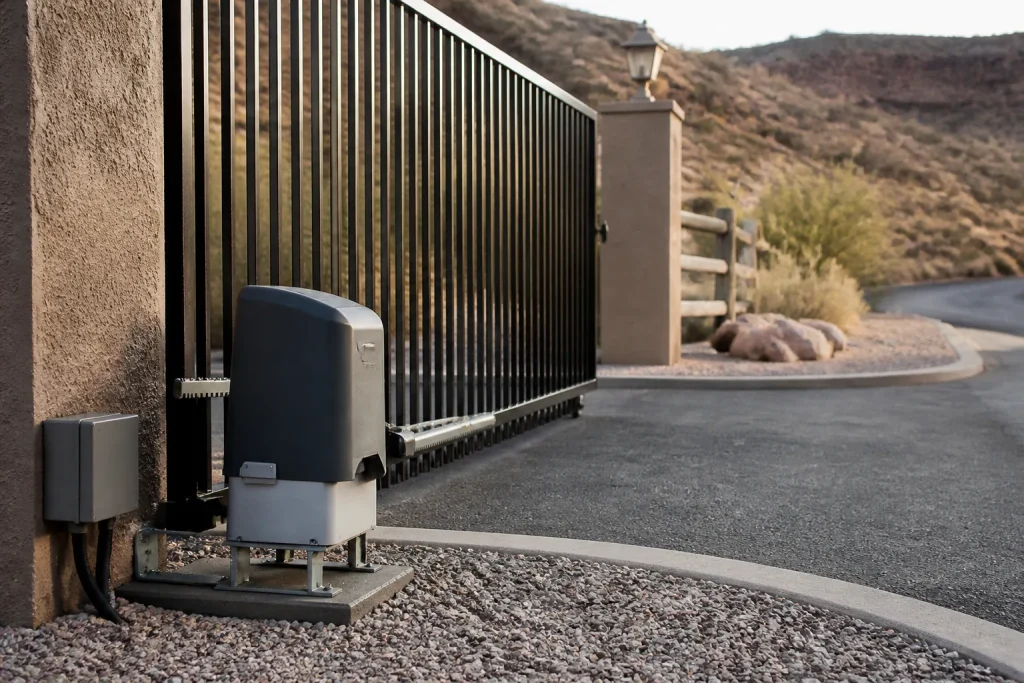
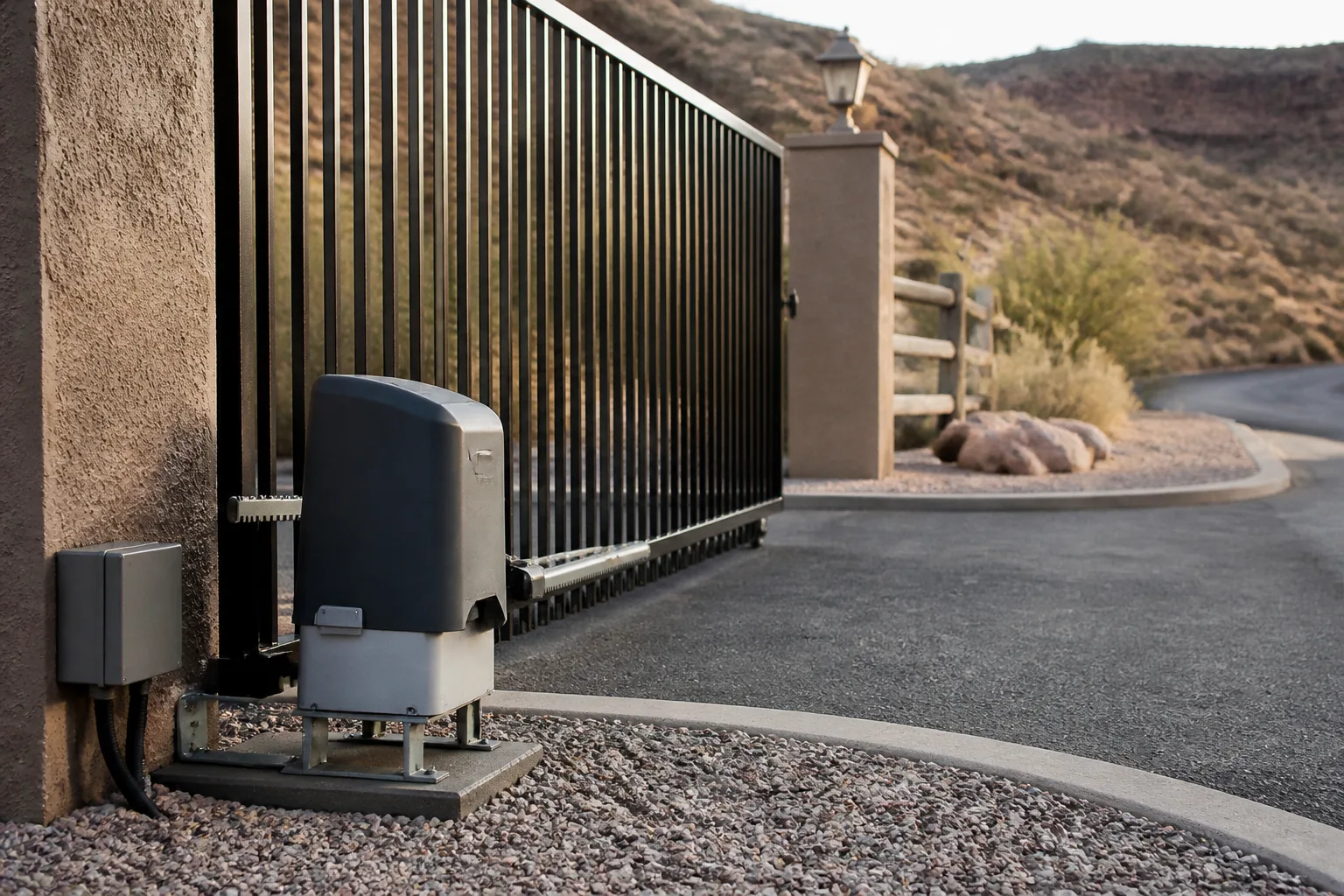
5 Mistakes to Avoid With Gate Motor & Opener
The most expensive gate motor mistake Winchester homeowners make isn’t buying the wrong unit. It’s letting any technician adjust limit switches or reprogram parameters without producing a before-and-after record. We’ve watched a $140 service call turn into a $700 repair because nobody wrote down what the motor’s limits were set to before someone “tweaked” them. Five mistakes cause most of the repeat visits we undo in Winchester, and every one of them comes down to documentation as much as mechanics.
Mistake 1: Leaving Factory Torque Settings on a Gate That Isn’t Factory Weight
A gate operator ships from the factory set for an average gate. Your gate is not average. A ten-foot steel driveway gate, a Viking arm on a sagging post, or a Ghost Controls unit bolted to a gate with a sticky hinge all push back harder than the spec sheet assumes. When torque stays at the factory default and the gate gets heavier or drags, the motor strains every cycle to overcome friction it was never calibrated for.
Here’s what that looks like after a year or two on a Winchester driveway: the operator runs hot, the arm groans at the halfway point, and eventually the control board or gearbox gives out well before its service life. We’ve seen this most often on older properties around the Westside, where a gate’s original posts have shifted with the clay soil and nobody reset the torque after the gate started dragging.
- What to check: whether your operator’s force or torque setting was matched to the actual measured gate weight and swing resistance, not left at default.
- The documentation tell: a competent technician writes down the torque value and the gate weight on the invoice. If that number isn’t on paper, it wasn’t set.
- Why it matters: underset torque stalls the gate; overset torque masks a dragging hinge while quietly wearing the motor. Both get expensive.
Mistake 2: Bypassing Safety Inputs and Forgetting to Restore Them
Safety edges and photo-eyes get bypassed all the time during testing, and that part is normal. Leaving them bypassed is not. A technician jumps the safety input to isolate a phantom stop, confirms the board is fine, and then walks away without undoing the jumper. The gate now closes on anything that crosses its path. That’s a physical danger to a child or a pet, and it’s an insurance and liability problem the moment it happens.
On a residential swing gate, the photo-eye is the infrared beam that stops or reverses the gate when something breaks the line. It’s the single most bypassed component we find on first visits, and it’s usually bypassed because it was misaligned by a couple of inches and flashing, not because it actually failed. Two inches of misalignment on a Westside driveway gate is remarkably common after a fence crew works nearby.
Every motor brand we service – LiftMaster, DoorKing, Elite, and the rest – has an input you can test and verify. The fix is procedural: any bypass gets logged, and the safety check gets run again before the technician leaves. Under the Haven Standard, the closing safety test is photographed and left with you, so “safe” is something you can actually see on paper.
Mistake 3: Never Testing Battery Backup Under Load
Most gate operators carry a backup battery so the gate still cycles during a power outage. The problem is a battery can read fine on a meter and still fail the instant it has to push a gate open on its own. It holds a surface charge, tests green, and dies the first time the grid actually drops – usually during a windstorm or an outage, which is exactly when you need the gate to move.
Testing under load means disconnecting line power and cycling the gate the full distance with the battery carrying the load. A battery that’s been quietly depleted for months shows up in that test and nowhere else. We’ve opened battery compartments in Winchester garages to find cells that hadn’t been load-tested in years and were already down on capacity. The first power cut was going to be an unwelcome surprise.
Ask when your backup battery was last tested under load, and whether the result was written down. If nobody can show you a number, it wasn’t tested.
Mistake 4: Verbal Programming Changes With No Parameter Record
A technician reprograms travel limits, soft-start, auto-close time, or force sensitivity from memory, says “that should do it,” and leaves. No record of which parameters changed, no before-and-after reading, no note of the original values. The next time something acts up, the next technician starts from zero – and you pay a second diagnostic fee to rediscover settings that were already changed once.
This is the mistake that quietly drives up the cost of every future visit. Without a parameter record, a full re-diagnosis is the only honest option, because there’s no baseline to work from. We build that record on Winchester jobs as a routine: limit-switch readings before and after, force settings, auto-close timing, and any parameter touched, all photographed and written down. If a limit switch was set twelve degrees past travel, that number goes on the page, with the corrected value beside it.
If your last service came with nothing but a handshake, you don’t have a record. That gap likely wasn’t clear until now. You can review a written scope of what a documented visit should include on our Gate Motor & Opener in Winchester page.
Mistake 5: Ignoring Intermittent Faults Because the Gate “Usually Works”
An intermittent fault is the most expensive thing to ignore, because it’s cheap while it’s small. A tired sensor that fails once a week is a $90 part. Let it limp along for a season, and the control board starts throwing errors every time the sensor misfires, until a $90 sensor replacement becomes a $600 board failure. The gate “usually works” right up until the board finally gives out. We’ve seen this spiral on plenty of driveway calls, but the pattern holds across every brand.
Intermittent faults get missed for a simple reason: they don’t reproduce on demand. A technician arrives, the gate runs fine, the visit ends. Catching one takes a documented history – what the gate did, when, and under what condition – so the pattern shows up on paper even on a good day. That’s the value of the photo-and-record habit we carry over from commercial access-control work: the trail points to the fault the gate won’t show you live.
- A sensor that fails only in the morning often means morning sun on the photo-eye.
- A gate that stops only mid-afternoon may point to a heat-related battery or board issue.
- A fault that shows up after rain usually means a wiring or alignment problem, not a bad board.
When to Call a Pro (and When You Can Wait)
You can safely reset a tripped breaker or clear an obvious obstruction from the gate’s path. Anything past that, on the motor side, needs a trained professional. Gate operators hold stored mechanical force and the arms under spring tension carry real hazard – a force test or limit adjustment done wrong can crush a hand or cause the gate to slam. Don’t open the control box to “test” a safety input yourself, and don’t adjust torque or limits without a reference measurement. That’s how undocumented changes happen in the first place, and it’s the exact mistake this whole post is about. This work belongs in the hands of someone who documents every change.
Related Services in Winchester
If a fault has already done its damage, our Gate Repair in Winchester service handles the troubleshooting and parts replacement. For property owners starting from scratch, Gate Installation in Winchester covers a fully documented install with written limits and torque from day one. And when you want us back to review a written estimate you got elsewhere, we’ll do it free. Start from the Vance Gate Repair Winchester home page to find the right next step.
What happens when you call
- 1
A real person answersNo phone trees – you reach a local pro.
- 2
You get an upfront price rangeHonest numbers before anyone is dispatched.
- 3
A background-checked tech heads outLicensed & insured, dispatched right away.
- 4
You approve before work beginsNothing starts until you say go.
The Bottom Line
Gate motor maintenance is a documentation discipline as much as a mechanical one. The five mistakes come down to torque left at default, safety inputs left bypassed, backup batteries never load-tested, programming changed with no record, and intermittent faults ignored until they’re expensive. Every one is cheaper to avoid than to fix. Our technicians carry up to 12 years of experience and can work on whatever motor is already on your property – Viking, DoorKing, FAAC, or anything else – rather than steering you toward a replacement.
Every job comes with a written price before any work starts, a documented photo record left with you, and the 365-Day Done Right Promise covering the work. A live person answers the phone around the clock. If you’re in Winchester and need help, Vance Gate Repair Winchester offers free estimates – call (866) 983-9213.
Frequently Asked Questions
No – leave limit-switch and torque adjustments to a trained technician. Those settings carry stored mechanical force, and a wrong value can jam the gate, strain the motor, or cause an injury. It also creates exactly the undocumented change this post is about. A pro records the before-and-after values so the next visit doesn’t start from scratch. Call (866) 983-9213 for a written estimate.
It should be load-tested at least once a year, and the result written down. A battery can read fine on a meter and still fail the moment it has to move the gate on its own. Testing under load means cutting line power and cycling the gate the full distance on battery alone. Call (866) 983-9213 to schedule a documented check.
An intermittent fault is usually a sensor, a wiring connection, or a battery that only fails under a specific condition – morning sun, heat, or rain. It rarely reproduces on demand, so it’s caught by a documented history rather than a single visit. Left alone, a small sensor fault can wear out the control board. Call (866) 983-9213 and ask for a documented diagnostic.
You should get the torque or force setting, the limit-switch readings before and after, any parameters changed, and a photo record of the work – all in writing, left with you. Since 2014 that record has been standard on every visit we make in Winchester, and it’s what saves the next technician a full re-diagnosis. Call (866) 983-9213 for an estimate with the price written before any work starts.
Written by the team at Vance Gate Repair Winchester.
Need Gate Repair Help?
Call Vance Gate Repair Winchester - licensed & insured, here with fast after-hours help in Winchester.
(866) 983-9213