
Gate Installation: Repair or Replace? How Winchester Homeowners Decide
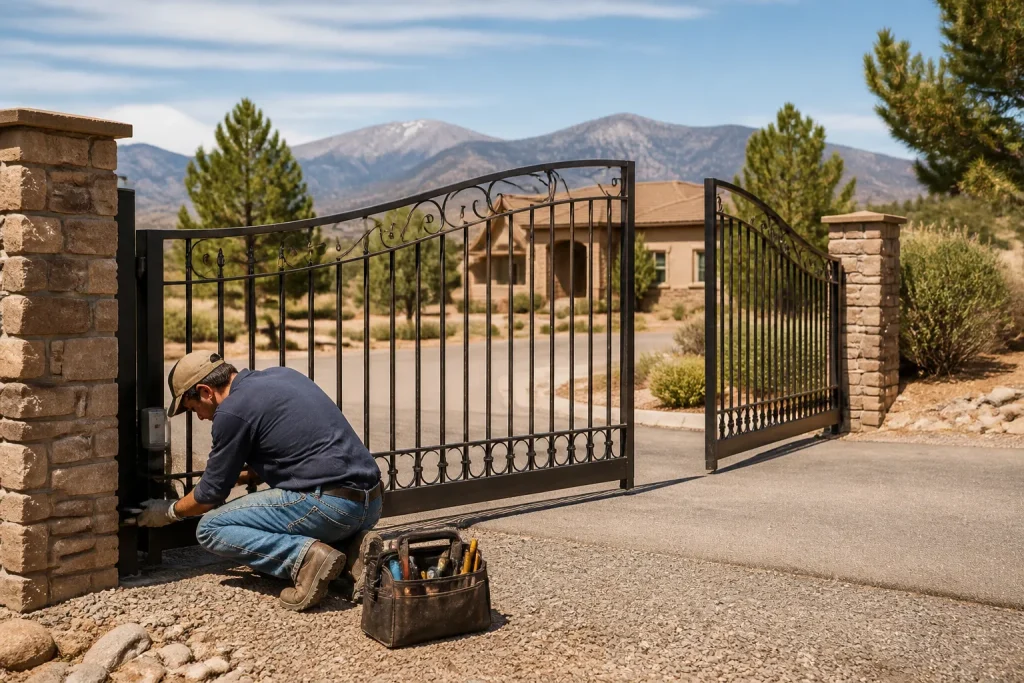
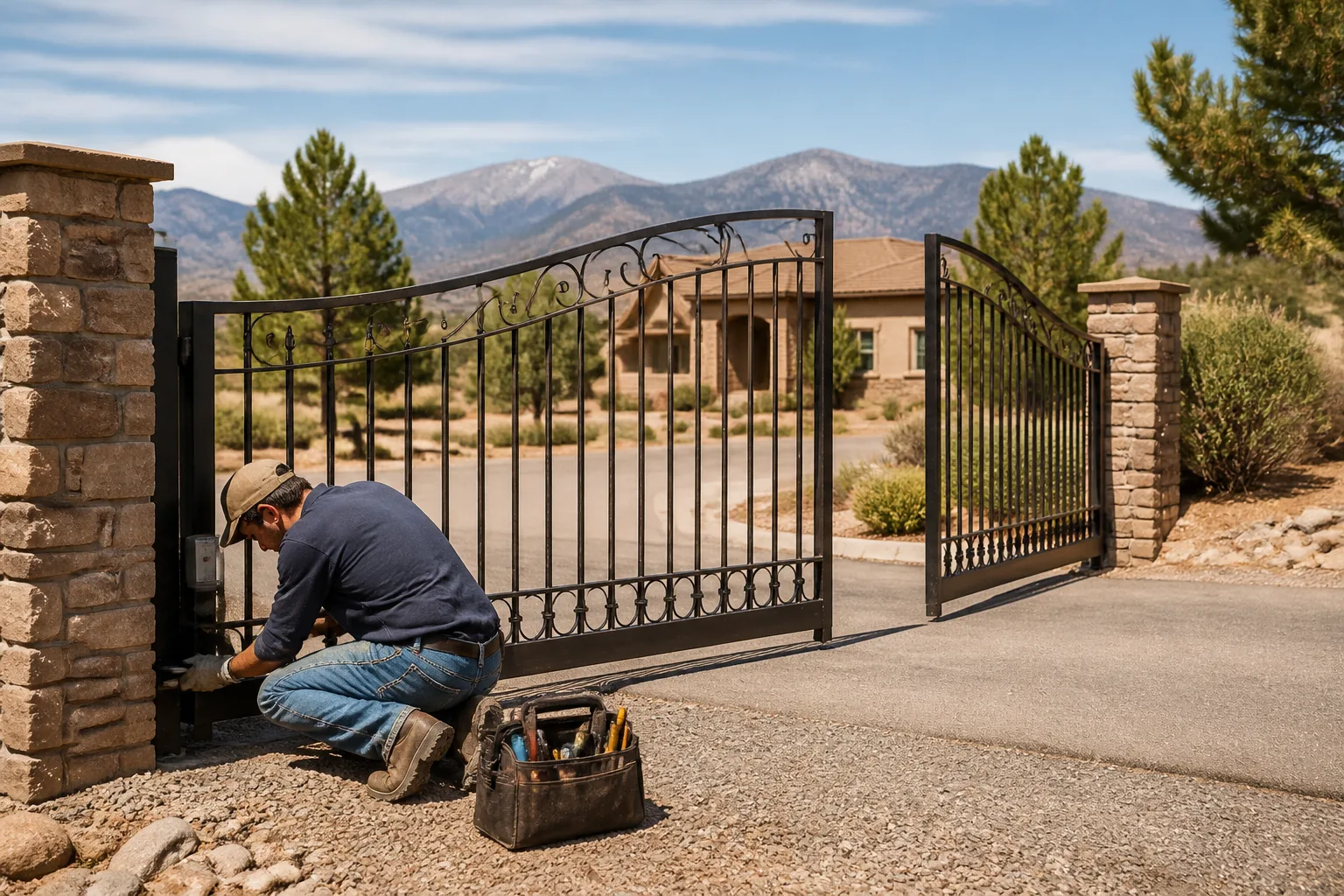
Repair or replace comes down to the foundation, not the gate. If the posts are plumb and the concrete footings are sound, even a gate that looks destroyed after a vehicle strike can often be repaired for under $300. If the footing has heaved and the whole assembly is slowly racking, a gate that still swings fine can run $4,000 or more to replace. Age and appearance tell you almost nothing. The posts tell you everything.
If you’d rather not crawl around checking plumb lines yourself, call (866) 983-9213 and we’ll walk the fence line with you.
How do I check whether my gate posts and footings are still sound?
You can answer most of this in ten minutes with a torpedo level, a tape measure, and a careful look at the concrete. Do this before you call anyone for an estimate, so you’re comparing written scopes instead of reacting to a sales pitch. Here’s what to check:
- Plumb on both posts. Hold the level against the hinge post, face and side. A post that’s out by more than about a quarter-inch over its height is starting to move. Check the latch post the same way.
- The gate’s own diagonals. Measure corner to corner across the gate frame. If the two diagonals differ by more than half an inch, the gate is racking, and it’s usually the posts pushing it there, not the gate itself.
- Footing condition at grade. Look for a gap between the concrete and the soil, a crack running down the side of the footing, or concrete that’s tilted rather than level. Any of those means water has been working underneath.
- The hinge plates. Rust streaks, elongated screw holes, or plates pulling away from the post mean the steel is tired. That’s fixable if the post is solid, and pointless to fix if it isn’t.
Write down what you find. We’ve watched homeowners in Winchester get two wildly different replacement quotes for the same gate and only realize later that one company measured the posts and the other just eyeballed them.
The three structural conditions that make repair uneconomical
We’re a repair-first operation. Most gates we see can be saved, and we’ll say so. But three conditions change the math, and no amount of new hardware fixes any of them:
- The footing has heaved or settled out of level. Once a footing has moved, you’re resetting concrete, and the gate has to come off anyway. At that point you’re paying for an installation with a repair’s labor attached.
- The post itself is rotted or cracked below grade. Steel posts rust from the inside out at the soil line; wood posts rot from the bottom up. If the post is failing where you can’t see it, the gate hanging on it is coming down whether you like it or not.
- The hinge-post concrete has cracked through and separated from the post. A hairline crack is normal. A crack you can slide a coin into means the post is no longer gripped, and every swing is slowly working it looser.
If none of those are present, you’re almost certainly looking at a repair: hinges, a sagging stile, a bent frame from a strike, or a latch that won’t catch. Those are the jobs we do every week across Winchester, and they don’t require a new gate.
Why Winchester’s caliche soil and freeze-thaw cycles change the replacement timeline
Winchester sits on caliche, that dense calcium-carbonate layer that turns a post hole into a fight with a digging bar. Caliche is actually good news for a footing that’s poured and set correctly, because it holds like rock. The trouble is the transition zone where the caliche layer meets looser soil, and how water behaves there. Rain that pools on a hard caliche shelf has nowhere to drain, so it works its way down the side of the footing and softens the soil underneath it.
Add the freeze-thaw cycles we get on the colder nights and the picture gets worse: water in a footing crack expands overnight and widens the crack a little more each winter. A gate that’s been fine for a decade can start leaning in a single bad season. That’s why we tell Winchester homeowners to check post plumb in early spring, after the last hard freeze, rather than in summer when everything looks stable. A quarter-inch of lean in March is a post you can still save. An inch of lean by August usually isn’t.
What a written scope must itemize before you approve a gate installation
A verbal estimate on a gate replacement hides scope, and the hidden scope is where the surprise invoice lives. A full installation quote should be a written document you can hold, and it should itemize at minimum:
- The gate itself: material, dimensions, frame construction, and finish
- Post replacement or reuse, stated explicitly, with footing depth and concrete specified
- Hardware: hinges, latch, and any operator bracket, named by part
- If a motor is involved, the brand and model, plus the power run and safety edges as separate line items
- Site prep and disposal of the old gate and concrete
- Permit responsibility, if your jurisdiction requires one for the installation
Under The Haven Standard, that written price is handed over before anyone picks up a tool. If a company won’t put the power run and the safety edges on paper, that’s your signal. We service nine major automation brands, including LiftMaster and DoorKing, so we can quote around the motor you already own rather than steering you toward a new one. If you have a written estimate from another company, bring it in: we’ll review it at no cost as a second opinion.
The documentation handoff: what to demand when a new gate goes in
When a gate is installed, you should walk away with a record, not just a gate. Ask for photos of the footings before they’re buried, the post plumb readings taken after set, and the exact part numbers of every hinge, latch, and bracket. If a motor is part of the job, ask for the wiring diagram and the limit-switch positions as set. This is ordinary practice on commercial access-control sites, and there’s no reason a residential gate in Winchester should be any different.
We pulled a gate out of a garage over near the older part of Winchester last month where the previous installer had left zero documentation. The homeowner had a motor that wouldn’t hold its open position, and we spent the first hour just tracing wires to figure out what brand we were even looking at. A single photo of the control board would have saved that hour. Under Clause 4 of the Haven Standard, every visit leaves a photo log of what we found, what we adjusted, and what we installed.
If you’re weighing an installation against a repair, our Gate Installation in Winchester page lays out the full scope, and Gate Repair in Winchester covers the fixes that keep an existing gate in service.
When to call a pro
If your post is out of plumb, a footing is cracked, or the gate is racking, stop before you touch it. High-tension gate springs and motorized arms store real force, and a gate that lets go while you’re under it is a genuine injury risk. Checking plumb with a level is safe. Resetting a footing or working around a tensioned spring is not. Call us and we’ll tell you what we see. For motor and operator questions, our Gate Motor & Opener in Winchester page is the place to start.
The Bottom Line
The decision isn’t about how the gate looks. It’s about whether the posts are plumb and the footings are intact. Check plumb and diagonals yourself, look for footing cracks at grade, and time your inspection to early spring when freeze-thaw damage shows. If the structure is sound, repair the gate and save the replacement money. If the footing has moved, a new gate on the old footing is money spent twice. Start from our Vance Gate Repair Winchester home page if you want the full picture of what we handle. If you’re in Winchester and need help, Vance Gate Repair Winchester offers free estimates, and a live person answers at any hour. Call (866) 983-9213.
Frequently Asked Questions
Most residential gate repairs in Winchester run between $150 and $600, depending on whether it’s a hinge or latch job or a bent frame from a vehicle strike. A repair on a gate with sound posts and intact footings stays in that range. We put the flat price in writing before any work starts.
Sometimes, if the lean is under about a quarter-inch and the footing hasn’t cracked. A small lean can often be corrected by resetting hardware. If the footing itself has heaved or the concrete has separated from the post, repair won’t hold and replacement is the honest answer.
A standard residential swing gate installation in Winchester usually takes one to two days, including footing set and cure time. Motorized gates take longer because the power run and safety edges are scheduled separately. That’s why installation is measured and scheduled rather than same-day.
Caliche soil holds water on a hard shelf, so drainage runs down the footing sides and softens the soil underneath. Winter freeze-thaw cycles then widen any crack a little more each year. The combination shortens footing life compared with looser, better-draining soils. Checking plumb in early spring catches the problem while it’s still cheap to fix.
Written by the team at Vance Gate Repair Winchester.
Need Gate Repair Help?
Call Vance Gate Repair Winchester - licensed & insured, here with fast after-hours help in Winchester.
(866) 983-9213